What Plato’s Key Could Do for Orchard’s AI
TL;DR Stanford showed that a simple map can make one language model use another’s hidden state for factual recall. Orchard’s first test would be whether a similar map lets a new embedding model search an existing project index without a full rebuild.

When an AI agent gives the wrong answer, it may have missed the source in project search or failed to recall a fact from its own training. Those are different failures. Stanford’s Hazy Research group found that supplying a hidden state from another language model can sometimes fix the second one. The same kind of alignment gives Orchard a way to test whether project search can survive a change of embedding model. Stanford Hazy Research’s Plato’s Key
What Stanford actually showed
A hidden state is a vector a model computes while reading a token. The team took the vector at the last token of a subject in one model. It centered, rotated and rescaled that vector to fit the coordinate system of a second model, then replaced one of the recipient’s hidden states with the result. The recipient’s remaining layers generated the answer. The map was fit on facts both models already recalled, and the test used different subjects from the fitting set. Both models’ weights stayed frozen. Stanford experiment and methods
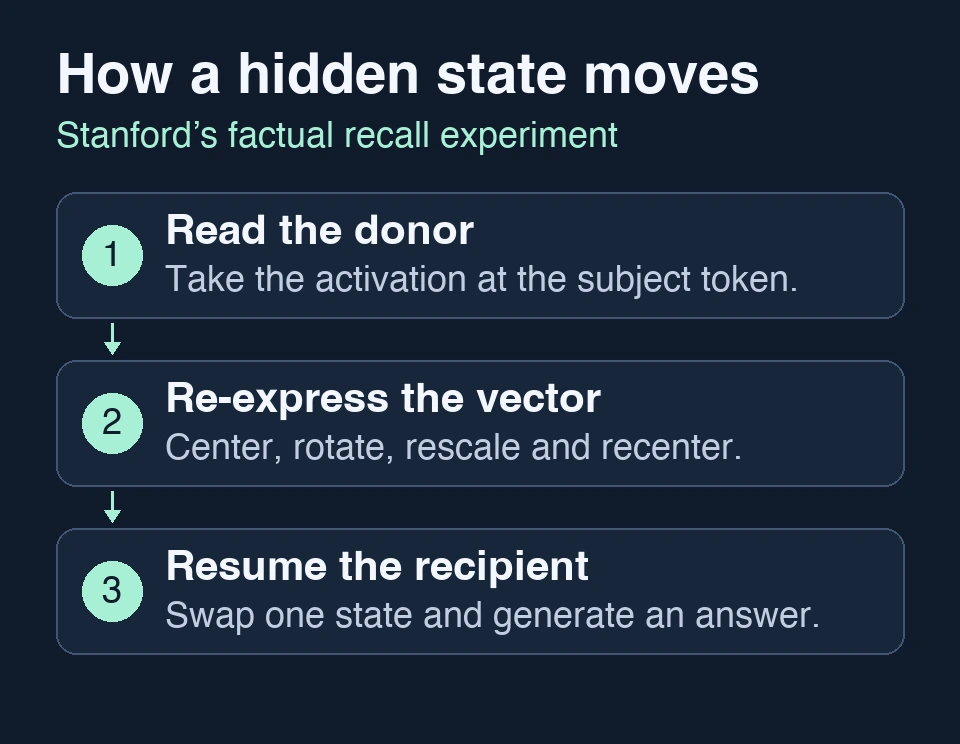
Across 20 pairs drawn from 12 base models, a swap produced the donor’s answer in a median 41% of trials per pair. Swapping a state from the recipient model itself reached 55%. In a separate test, the donor knew the answer and the recipient missed it on the direct prompt. The researchers found 1,463 misses where the recipient could still surface the answer under a probe such as a rephrased question or ranking candidate answers. A mapped donor state recovered 267 of those 1,463 cases, about 18% of that selected subset. Stanford results
The researchers also composed two maps through a third model without running that model. Those chains retained a median 99% of the direct map’s transfer accuracy in the tested setup. That makes a shared coordinate space plausible enough to investigate. Stanford’s chaining experiment
Earlier work demonstrated that simple maps can join independently trained encoders and decoders. Stanford’s contribution here is a direct test inside language models. The measured result concerns factual recall in base models. Multi-step reasoning, work with post-trained assistants, and end-to-end inference savings remain research questions. Latent Space Translation via Semantic Alignment · Stanford’s research directions
First Orchard experiment: upgrade project search without rebuilding the index
Trellis helps Orchard agents retrieve relevant project memory. An embedding model gives a query and the indexed material coordinates that search can compare. If we replace the model, the new query and old index may sit in different coordinate systems. A compatibility map might let us use the new model while the old index stays readable. This adapts the alignment idea to search embeddings, which are separate from the hidden states Stanford patched. How Orchard works
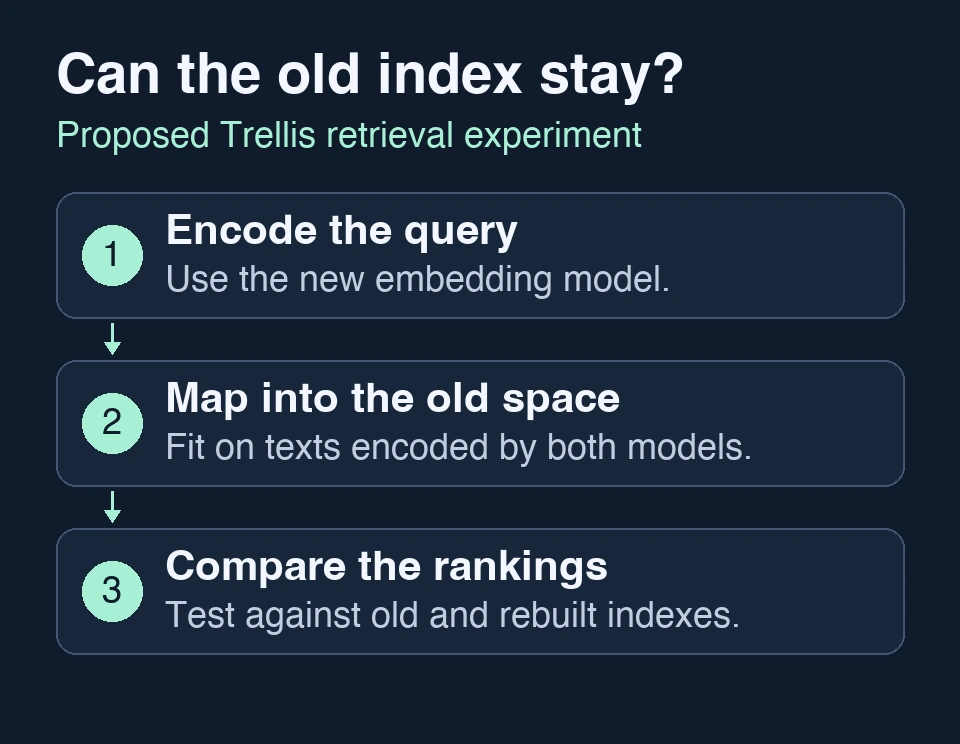
Imagine an agent trying to recover the decision that explains why a release step exists. A useful migration preserves the ranking of the actual decision record when the question is phrased differently. We would fit the map on authorized text encoded by both models, then test a frozen copy of the old index on held-out questions and documents. We’d compare the mapped query with the old model and old index, a fully rebuilt new index, our usual hybrid search, and a map fit with shuffled pairs. The existing project access rules and citations would apply in every arm.
The measures that matter are whether the right source appears in the first few results, where it ranks, and what it costs to get there. We’d score recall at five and ranking quality against relevance labels, inspect regressions by topic, and measure tail latency and re-indexing work. If the adapter preserves retrieval quality while avoiding substantial rebuild work, it could serve as a reversible bridge during upgrades. The old encoder provides a fallback. A rebuilt index remains the reference for what the new encoder can deliver on its own.
Second Orchard experiment: help a local model recall a fact it missed
Orchard supports configured local inference. A research harness could run two open-weight models with access to their intermediate layers, then try a mapped activation when the smaller model struggles with a public factual question. The harness needs access to read and replace a hidden state at a specific layer and token. An ordinary hosted chat endpoint exposes generated text, so this experiment needs a runtime with deeper instrumentation. Orchard’s local inference and project memory
Give every approach the same held-out questions. Compare the recipient alone, a second prompt or paraphrase, the donor alone, the donor’s answer passed as text, and retrieval from a cited source. Test the activation map against shuffled and random controls. Count newly correct answers and previously correct answers that became wrong. Measure end-to-end latency and peak memory, including the donor pass. If forwarding the donor’s text gives equally reliable answers at lower cost, the text handoff wins. When a question concerns an Orchard project decision, the project record provides evidence that a repaired model answer still needs.
The first practical bet is the Trellis migration test. It has a clear success criterion. Agents should keep finding the right evidence while we change the model behind search. The local recall test asks whether two models together can give more reliable answers than a single model or a simple handoff.